
NEW CONSTRUCTION
Cheaper to build, but fewer people building
Here’s the direct answer. Kelowna cut its development cost charges by 25% in August, which takes roughly $9,000 to $13,000 off the fees on a new single-family home. At the same time, housing starts across British Columbia are down about 10% for the year. So building got cheaper and slower at once. In a hillside community like Wilden, where most of what sells is either newly built or a few years old, that combination matters more than it does almost anywhere else in the city.
Let me walk through what actually changed and what I think it does to pricing.
What the fee cut actually is
Development cost charges are the fees a municipality collects from builders to pay for the infrastructure new housing needs. Roads, water, sewer, parks. They get baked into the price of the finished home, which is why they end up being a buyer’s problem and not just a builder’s.
On July 27 council adopted a temporary 25% reduction, effective August 4, 2026 and running through September 30, 2028. The city’s own figures put the saving at $9,000 to $13,000 per single-family home and $7,000 to $9,500 per apartment unit.
The city expects to give up $20 to $25 million in revenue over the two years. Staff estimated the cut might bring forward 200 to 350 units that otherwise would not get built.
Read that last sentence again, because it is the honest framing. This is not a policy designed to make houses cheaper. It is a policy designed to make marginal projects viable. Those are different goals, and only one of them shows up on a price tag.
The other half of the picture
Now the part that does not make headlines. CMHC’s most recent numbers have British Columbia’s year-to-date housing starts at 22,498 units, down from 25,010 the year before. That is a drop of about 10%. Vancouver is down 42% year over year.
Nationally, starts fell 5% month over month.
So the province is building meaningfully less than it was, and a fee cut worth ten grand a door is arriving into that. Ten thousand dollars is real money, but it is not what is stopping projects. Construction costs, financing costs and absorption are. The clearest local evidence of that is BC Housing walking away from its own 176-unit tower on Bertram Street this summer, citing costs that came in over budget against a rental market that could no longer support them.
When a government agency cannot make its own flagship project pencil, a 25% DCC reduction is a nudge, not a fix.
And there is a newer pressure arriving from the other direction. The United States put 50% tariffs on Canadian lumber, plywood and cement on August 22, and Canada’s retaliatory tariffs on more than 700 American goods, building inputs among them, take effect September 8. I want to be careful here, because the eye-catching numbers circulating on this are American estimates of what tariffs add to an American home. Those do not transfer to a build in Kelowna. What does transfer is straightforward: some of what goes into a house here is sourced from the United States, and from September 8 those inputs cost more.
So the fee relief is a known $9,000 to $13,000. The material cost pressure is real but not yet quantified locally. I would not assume the first comfortably outruns the second.
Why this lands differently in Wilden
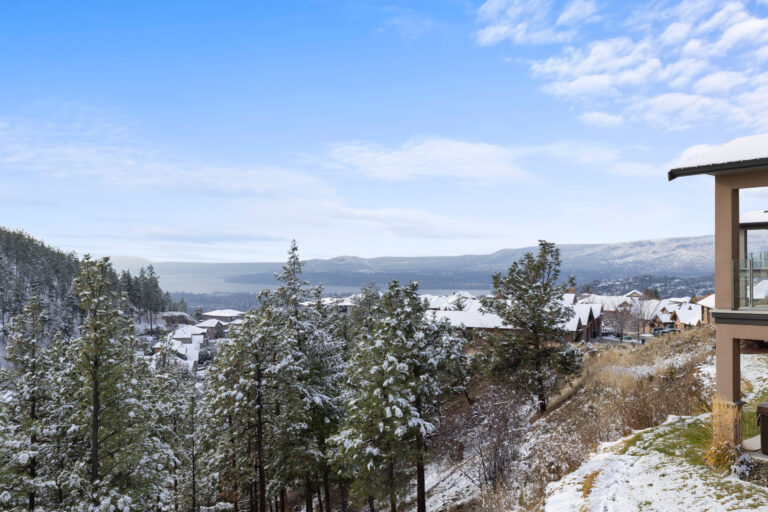
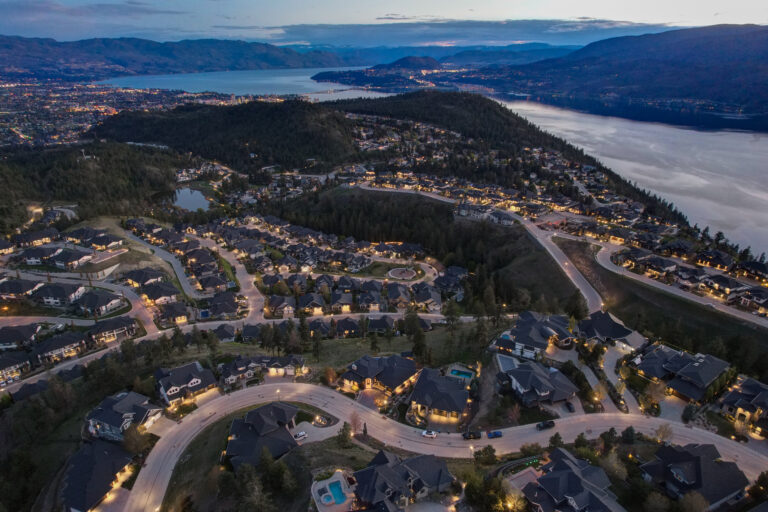
Most Kelowna neighbourhoods are largely built out. What trades there is existing stock, and construction policy is background noise. Wilden is not that. It is an active hillside community where a meaningful share of what comes to market is new or nearly new, and where the supply pipeline is a live thing rather than a historical fact.
That cuts both ways.
The case that it helps. Lower fees on new builds put slightly less pressure on new-construction asking prices. If a builder’s costs drop ten thousand dollars on a lot, some of that can show up in what they are willing to accept, particularly on a home that has been sitting.
The case that it does not. A saving of $9,000 to $13,000 against a hillside build that lists well north of a million is roughly one percent. In a market where the typical Central Okanagan seller is already taking about 95.7% of their original asking price, one percent is inside the noise. It will not be the reason a deal happens.
My honest read: the fee cut is worth knowing about and it is not worth waiting for. If you are buying a new build in Wilden, the negotiating leverage in this market comes from inventory and time, not from a bylaw.
The supply question underneath all of it
There is a third piece, and it is the one I would actually pay attention to if I owned in a hillside community.
In August, council declined to advance early rezoning on about 27 acres of hillside land in the Hall Road area. The reasoning was not about that specific site so much as policy. The application ran against the Official Community Plan’s position on suburban sprawl, its policy against subdivision outside the permanent growth boundary, and its requirement that the area go through comprehensive neighbourhood planning first. Hillside topography, environmental sensitivity and wetland proximity were all in the file.
That is a different quadrant of the city from Wilden. But the reasoning travels. Kelowna is signalling, fairly consistently, that it would rather densify inside the growth boundary than approve new hillside subdivision outside it.
If you own on a Kelowna hillside, that is a long-run supply constraint working in your favour. Not this month, and not this year. But the number of communities like Wilden that will ever exist in this city is closer to fixed than most people assume.
What I would actually do with this
If you are buying new construction in Wilden. Do not treat the fee cut as a reason to move faster. Treat the current market as the reason to negotiate harder. Central Okanagan detached inventory sits around ten months of supply, sales fell sharply from July into August, and homes are taking about 45 days to sell region-wide. That is a buyer’s market by any standard reading, and it is a far bigger lever than a DCC reduction. If you want the current numbers before you write anything, the Kelowna market report is updated monthly.
If you are selling a newer home in Wilden. Know that you are competing with builders whose costs just went down slightly and whose patience is finite. A builder carrying financing on unsold inventory will move on price before a homeowner will. The buyers walking through your home are comparing it to what’s listed around you today, so that’s the best place to anchor your price. That is most of how I approach a listing.
If you are a few years out. The supply signal is the thing to watch. Fee cuts expire in 2028. Growth-boundary policy does not.
One more thing about August, and it is the part the numbers cannot show you. Between the smoke and the evacuation alerts, including the fire at Summerland, it felt like half the valley left town. Visitors and locals both. I think that is a real part of why August looks the way it does, and I would not be surprised if the months ahead read closer to the trend we were on before the smoke arrived than to August itself. Treat a single month like this as a snapshot taken on an unusual day.
All market figures here are Central Okanagan detached sales as of September 2026, drawn from Association of Interior REALTORS® MLS® System data for the month of August 2026. Late-reported sales can move a recent month slightly.
One honest caveat on the local numbers: August was a thin month in Wilden specifically, with only three detached sales recorded. That is far too few to draw a neighbourhood price trend from, and I am not going to pretend otherwise. The regional figures are solid. The Wilden-specific ones this month are a sample, not a signal.
The bottom line
Kelowna made it modestly cheaper to build at exactly the moment fewer people wanted to. The fee cut is real and it is small. The slowdown in starts is real and it is larger. And underneath both, the city keeps declining to open new hillside ground.
For a buyer in Wilden right now, none of that beats the plain fact that there is a lot of inventory and not many competing offers. Use that. For an owner, the policy backdrop is quietly more supportive than the current month’s numbers suggest.
Statistics in this post are compiled by Braden Koop Personal Real Estate Corporation from sales recorded on the Association of Interior REALTORS® MLS® System, current to the dates given in the post, published September 2026. NOTE: this representation is based in whole or in part on data generated by the Association of Interior REALTORS®, which assume no responsibility for its accuracy. The analysis is my own. Information is deemed reliable but not guaranteed, and figures can be revised as sales are reported. This is general market information, not advice on any one property. The trademarks REALTOR®, REALTORS® and the REALTOR® logo are controlled by The Canadian Real Estate Association (CREA) and identify real estate professionals who are members of CREA. The trademarks MLS®, Multiple Listing Service® and the associated logos are owned by CREA and identify the quality of services provided by real estate professionals who are members of CREA.